Hard water is not a comfort problem. It's a line item. According to the Battelle Memorial Institute study commissioned by the Water Quality Research Foundation, running a gas water heater on 30 gpg hard water makes it 24% less efficient than the same unit on softened water. Water heating is already about 18% of your home's energy use per the U.S. Department of Energy — the second-largest energy expense in most American homes. And when scale finally kills the tank, replacement runs $881 to $1,825, per Angi.
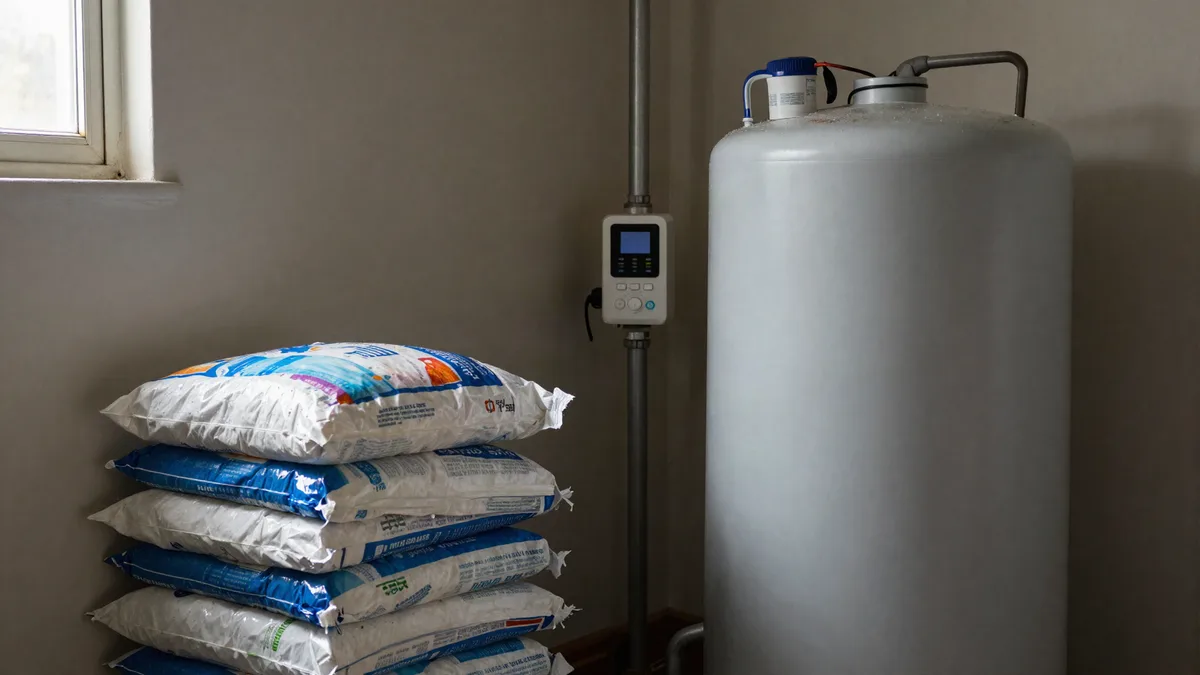
The classic fix is a salt-based water softener. It works — but it needs a drain, a power outlet, 40-pound salt bags every month, and it's outright banned in a growing list of communities. Which is why you're probably here: searching for a salt-free water softener alternative and wondering which ones are legitimate.
Here's the honest version, with sources.
Step one: find out how hard your water actually is
Every recommendation below depends on one number. The U.S. Geological Survey classifies water hardness as calcium carbonate concentration: 0–60 mg/L is soft, 61–120 mg/L moderately hard, 121–180 mg/L hard, and anything above 180 mg/L very hard. U.S. equipment specs usually use grains per gallon (1 gpg = 17.1 ppm), so "very hard" starts around 10.5 gpg.
Per USGS mapping, most of the country sits in the moderately-hard-to-very-hard range, with the Midwest and Southwest hit hardest. Before spending a dollar on any system, check your state on our free U.S. water hardness map — a household in Phoenix (frequently 15+ gpg) and one in Seattle (soft) should not buy the same equipment.
The three technologies, without the marketing fog
The industry uses "softener," "conditioner," and "descaler" almost interchangeably. They are three different machines.
Salt-based water softener (ion exchange). The only technology that actually removes calcium and magnesium, swapping them for sodium ions. Water tests soft afterward. It's the benchmark — and the only category covered by a dedicated performance certification (NSF/ANSI 44).
Salt-free water conditioner (TAC). Template-assisted crystallization doesn't remove hardness minerals; it converts them into microscopic crystals that stay suspended instead of sticking to pipes. "Salt-free water softener" is technically a misnomer — your water still tests hard — but the scale-prevention evidence is strong (numbers below).
Electronic water descaler (electromagnetic). A coil wrapped around your incoming pipe applies a varying electromagnetic field to the water. No plumbing cuts, no cartridges, no drain. The claim: the field changes how dissolved calcium carbonate crystallizes, so it forms soft aragonite crystals that rinse away instead of hard calcite scale. This is the category LIMPEO builds in — and the one with the most mixed evidence, which we'll address head-on.
| Salt softener (ion exchange) | Salt-free conditioner (TAC) | Electronic descaler |
|---|
| Removes hardness minerals | Yes | No (crystallizes them) | No (alters crystallization) |
| Scale prevention evidence | Benchmark (NSF/ANSI 44) | > in ASU lab testing | ~50% in the same ASU protocol; other studies mixed |
| "Soft water feel" (soap, skin) | Yes | Partial | No |
| Typical cost | $200–$6,000 installed, ~$1,500 average (Angi) | Between the two (tank + media, no drain) | ~$104–$460 retail, DIY install |
| Ongoing cost | Salt $5–$25/month + 20–70 gal water per regeneration | Media replacement every few years | A few dollars/year of electricity |
| Adds sodium / wastes water | Yes / Yes | No / No | No / No |
| Legal everywhere in the U.S. | No — chloride-discharge bans in parts of CA, TX, AZ | Yes | Yes |
Does it actually work? The science, honestly
This is where most articles in this category start lying by omission. Here's the full picture.
The mechanism is real chemistry. Calcium carbonate precipitates in several crystal forms. Calcite is the one that cements onto heating elements as rock-hard scale. Aragonite and vaterite form softer, less adherent crystals that tend to stay in the flow. Physical water treatment aims to push precipitation toward those forms. A 2024 peer-reviewed study in Water analyzing real distribution-system deposits found electromagnetic treatment measurably shifted scale composition toward aragonite.
The best independent benchmark. In 2011, Arizona State University ran a WateReuse-funded evaluation of softener alternatives (Fox, Wiest et al.), testing devices for 21 days against controlled hard water and weighing the scale that formed on heating elements. Results: template-assisted crystallization cut scale by more than . Electrically induced precipitation and magnetic/electromagnetic treatment cut it by roughly 50%.
The evidence against. Not every test succeeds. A 2024 review and experiment on magnetic water treatment found no statistically significant scale reduction in its own rig, and the wider literature on permanent-magnet devices (the clamp-on magnets sold for $30) is largely negative. Results for powered electromagnetic units vary with water chemistry, flow rate, and pipe material — and unlike softeners, there is no NSF/ANSI performance standard for this category, which is exactly why the market is full of unverifiable claims.
What that means in practice. A 50% scale reduction is genuinely valuable on the component that matters most — your water heater — but it is not "soft water." An electronic descaler will not make soap lather better, will not stop water from testing hard, and its effect fades the longer water sits downstream. Any brand telling you otherwise is selling. We publish the full mechanism, including the open questions, on our science page, and you can see exactly how the signal is generated on how it works.
The math: what hard water costs a U.S. household
Pulling the sourced numbers together for a home on hard water (20–30 gpg):
- Water heater efficiency: every 5 gpg costs about 4% efficiency on a gas storage heater (Battelle/WQRF). Since water heating is ~18% of home energy use (DOE), a 24% efficiency hit quietly inflates a major slice of your utility bill, month after month.
- Tankless owners, pay attention: in the Battelle testing, tankless water heaters on 26 gpg water failed completely from scale plugging after the equivalent of 1.6 years of use. Electric tank heaters accumulated 0.4 lb of rock-like scale per year for every 5 gpg.
- Fixtures: showerheads on hard water lost 75% of their flow rate in under 18 months in the same study.
- Replacement risk: an average tank replacement is $1,346 (Angi, $881–$1,825 range).
Against that, the two paths:
Softener path: roughly $1,500 average installed (Angi), plus $5–$25/month in salt (HomeAdvisor), plus 20–70 gallons of water sent down the drain per regeneration cycle (Sensorex). On very hard water it can still pay for itself — Battelle found softening a tankless system on sufficiently hard water can recoup the softener's cost in about a year.
Electronic descaler path: U.S. market units run from about $104 (iSpring ED2000) through $179 (Yarna CWD24) and ~$180 (Eddy) up to ~$460 (HydroFLOW HS38). Installation is a screwdriver and ten minutes; running cost is a standard wall outlet. The honest framing: you're risking a three-digit sum against partial protection of a four-digit appliance — a defensible bet at moderate hardness, and a complement (not a replacement) for a softener at extreme hardness. Compare LIMPEO models on the products page.
The part softener companies skip: salt is getting banned
Salt softeners regenerate by flushing brine into the sewer, and municipal treatment plants can't remove chloride. In California's Santa Clarita Valley, voters passed Measure S in 2008 and salt-discharging softeners became illegal and subject to mandatory removal, per the L.A. County Sanitation Districts — to protect the Santa Clara River and downstream agriculture. Other California districts, plus communities in Texas and Arizona, restrict brine-discharging softeners for the same reason. If you live in one of them, "salt-free alternative" isn't a preference. It's the law.
Bottom line: who should buy what
- Very hard water (15+ gpg), want the soft-water feel, no local brine restrictions: buy a salt softener. Nothing else replicates it.
- Hard water, but you want zero salt, zero waste water, or you're under a chloride ban: a TAC conditioner is the best-evidenced salt-free option.
- Moderate to hard water, renting, tankless heater at risk, small budget, or no space/drain for a tank system: an electronic descaler is the lowest-cost, lowest-commitment protection — with the caveats stated above, in writing.
Start with the number that decides everything: look up your state's water hardness.
Frequently asked questions
Do electronic water descalers really work?
Partially, and it depends on conditions. The best independent lab benchmark (Arizona State University, 2011) measured roughly 50% scale reduction for electromagnetic treatment, while some other studies found no significant effect. They reduce scale buildup; they do not soften water.
What's the difference between a water softener and a water conditioner?
A softener removes calcium and magnesium from water via ion exchange, so water tests soft afterward. A conditioner (salt-free or electronic) leaves the minerals in the water but changes how they crystallize so less scale sticks to pipes and heaters.
Will a salt-free system make my water feel soft?
No. The slick-water feel, better soap lather, and spot-free glasses of a true softener come from removing hardness minerals. Salt-free conditioners and electronic descalers leave minerals in the water — they target scale damage, not feel.
How much does hard water actually cost per year?
The Battelle/WQRF study found gas water heaters lose about 4% efficiency per 5 gpg of hardness (24% at 30 gpg), on a bill where water heating is ~18% of home energy use (DOE) — plus faster fixture and appliance replacement, like showerheads losing 75% of flow within 18 months.
Are salt water softeners banned in California?
In some communities, yes. There's no statewide ban, but districts can prohibit brine-discharging softeners; in the Santa Clarita Valley they've been illegal since 2009 under the Santa Clara River Chloride Reduction Ordinance.
Sources