Limescale never fails loudly. It costs you a water heater at year 8 instead of year 15, a dishwasher heating element at year 6, and an espresso machine that dies the month after the warranty ends. The damage is slow, cumulative, and almost entirely preventable — if you match your maintenance schedule to your actual water hardness instead of guessing.
This is the practical playbook: what to do, how often, appliance by appliance, with every number sourced. Before anything else, find your hardness in grains per gallon (gpg) on our US water hardness map — every schedule below scales with that number.
Water heater: the most expensive victim
Your water heater is where limescale does its worst work. Scale precipitates fastest on hot surfaces, so the tank bottom (gas) or heating elements (electric) collect a growing layer of mineral sediment that insulates the water from the heat source. The heater runs longer, costs more, and dies earlier.
Flush the tank. The U.S. Department of Energy recommends draining about a quart of water from the tank every three months to clear sediment. Manufacturers like A.O. Smith and Rheem add a full tank flush once a year — every six months in hard water areas. One warning: sediment compacts, and a never-flushed older tank can be hard to drain at all.
Check the anode rod. The sacrificial anode is a magnesium or aluminum rod that corrodes so your tank doesn't. A.O. Smith's guidance: inspect yearly on hard or well water, every two years on soft municipal water, and expect replacement roughly every 3–5 years. A $30–$60 rod is the single cheapest way to extend a $1,200–$2,000 heater's life. Most homeowners never touch it.
The temperature trade-off (read this part carefully). The DOE recommends setting your water heater to 120°F: it cuts water heating costs by 6–10% versus 140°F and sharply reduces scald risk — the CPSC notes that 140°F water can cause a serious burn in seconds, while 120°F water takes several minutes. Lower temperature also slows scale formation, since calcium carbonate precipitates faster in hotter water.
But here is the nuance most blogs skip: the CDC and OSHA recommend storing hot water at 140°F, because Legionella bacteria can survive and multiply in tanks kept at lower temperatures. For most healthy households on chlorinated municipal water, 120°F is the standard, DOE-endorsed setting. If your household includes immunocompromised people, or you're on well water, the safer engineering answer is a tank at 140°F plus a thermostatic mixing valve that delivers 120°F at the tap: Legionella control in the tank, scald protection at the fixture. It costs a plumber visit, but it's the honest version of this advice.
Dishwasher and washing machine: monthly discipline
Both appliances heat water internally, which makes them scale magnets — on heating elements, spray arms, jets, and water-level sensors.
Dishwasher. Whirlpool recommends running a cleaning cycle with a dishwasher cleaner (affresh or equivalent) monthly to prevent filming and mineral buildup; above roughly 10 gpg, every three weeks. The vinegar alternative — two cups in a bowl on the bottom rack, full cycle — works, but Whirlpool cautions that frequent use can degrade rubber seals and hoses. Occasional, not monthly. Keep the filter clean (monthly rinse) and use rinse aid — cloudy glassware in hard water is usually mineral film, not detergent failure.
Washing machine. Same logic: a clean-washer cycle with a cleaner tablet monthly, more often in hard water. Scale and detergent scum build up in the drum, heater, and dispenser drawer. Hard water also blunts detergent, so people overdose it, which feeds the scum. Above 7 gpg, use the detergent's hard-water dosing line.
Coffee gear and kettles: descale by hardness, not by habit
Small appliances with heating elements and narrow water paths are the fastest to clog. Keurig's own guidance is to descale every 3–6 months; with hard water, every 1–3 months. Translated into a rule you can actually use:
- Under 3.5 gpg (soft): descale every 6 months.
- 3.5–7 gpg (moderate): every 3 months.
- 7–10.5 gpg (hard): every 1–2 months.
- Over 10.5 gpg (very hard): monthly, no exceptions.
Citric acid or a commercial descaler both work; follow the machine manufacturer's instructions, since some (notably espresso machines with boilers) void warranties over vinegar use. Electric kettles are the easy case: fill with a 1:1 water-vinegar mix, boil, let sit 20–30 minutes, rinse thoroughly. If your machine has a water filter cartridge, replace it on schedule — it delays scaling but doesn't stop it.
Showerheads and faucets: the vinegar protocol
Clogged spray nozzles and crusty aerators are cosmetic damage that becomes flow damage. The fix costs almost nothing:
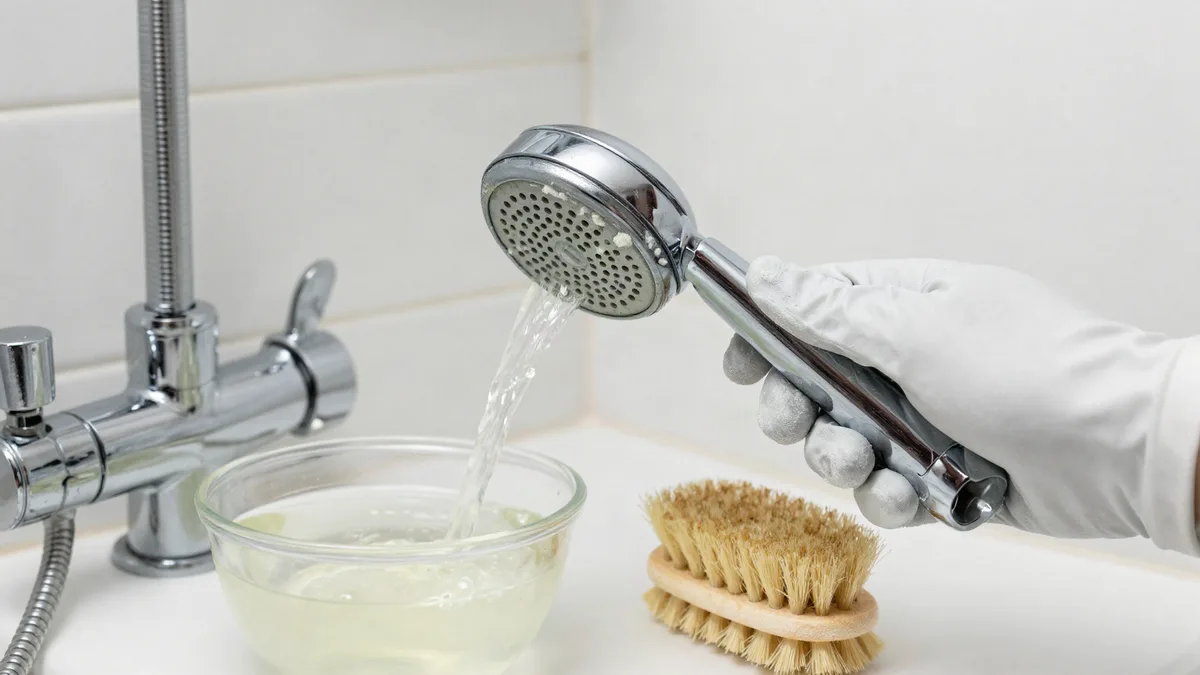
- Fill a plastic bag with white vinegar, submerge the showerhead, secure with a rubber band.
- Soak 30 minutes to 2 hours. Not longer on brass, nickel, or oil-rubbed bronze finishes — extended acid contact can etch or discolor them. For those, wipe with a vinegar-dampened cloth instead.
- Rinse, run hot water, and scrub remaining deposits from the nozzles with a toothbrush.
Unscrew faucet aerators and soak them the same way. In hard water areas, do this monthly; in soft water areas, quarterly is plenty.
Pipes: when scale becomes structural
Inside your walls, scale narrows hot water lines the way plaque narrows arteries — slowly, then noticeably. Copper and galvanized steel pipes scale the worst; PEX and CPVC resist adhesion better but their fittings and valves still collect deposits.
Warning signs that scale has moved from cosmetic to structural: hot water pressure noticeably lower than cold at the same fixture, banging or kettling noises from pipes or the water heater, and fixtures at the far end of the house running weak. There's no maintenance cycle for the inside of your walls. Once flow is noticeably restricted, the realistic options are professional descaling or repiping — both four-figure jobs. That makes pipes the one place where prevention is the only affordable strategy.
Stop it at the source: your three real options
Room-by-room maintenance treats symptoms. Above roughly 7 gpg, whole-house treatment at the point of entry is worth evaluating. Three technologies have real evidence behind them — and they are not equivalent.
Salt-based ion exchange softener. The reference solution. It physically removes calcium and magnesium, so scale essentially stops forming. Downsides: $1,500–$3,000 installed, ongoing salt costs, wastewater discharge (banned or restricted in parts of California and other states), and added sodium in your water.
Template-assisted crystallization (TAC). A salt-free media that converts hardness minerals into stable crystals that don't stick to surfaces. In the Arizona State University study for the WateReuse Research Foundation (Fox et al., project 08-006), TAC reduced scale formation by more than — the best-performing salt-free technology tested. Cartridge replacement is the recurring cost.
Electronic/electromagnetic descalers. This is what we make, so weigh our words accordingly — and here is the unvarnished data point: the same ASU study measured roughly 50% scale reduction for electromagnetic water treatment. Not 100%, not — about half. What it offers in exchange: no plumbing modification, no salt, no cartridges, no wastewater, and the lowest cost of the three by a wide margin. For moderate hardness, or as damage reduction combined with the maintenance schedules above, that trade can make sense. For 15+ gpg water and scaled-up pipes, a softener or TAC is the more complete fix, and we'd rather tell you that than sell you the wrong tool. The full evidence review — including where electronic descaling works well and where it doesn't — is on our science page, and the mechanism is explained on how it works. If your situation fits, our systems are here.
Your maintenance calendar, by water hardness
Check your tier on the US hardness map, then run this schedule:
| Task | Soft (<3.5 gpg) | Moderate (3.5–7) | Hard (7–10.5) | Very hard (>10.5) |
|---|
| Water heater: drain 1 quart (DOE) | Quarterly | Quarterly | Quarterly | Quarterly |
| Water heater: full flush | Yearly | Yearly | Every 6 months | Every 6 months |
| Anode rod inspection | Every 2 years | Every 2 years | Yearly | Yearly |
| Dishwasher cleaner cycle | Every 2 months | Monthly | Monthly | Every 3 weeks |
| Washer clean cycle | Every 2 months | Monthly | Monthly | Every 3 weeks |
| Coffee maker descale | Every 6 months | Every 3 months | Every 1–2 months | Monthly |
| Kettle descale | Every 6 months | Every 3 months | Monthly | Monthly |
| Showerhead/aerator vinegar soak | Quarterly | Quarterly | Monthly | Monthly |
Two hours a quarter, roughly. Against a $1,500 water heater replacement and a $1,000+ appliance graveyard, it's the best hourly rate in home maintenance.
FAQ
Should I set my water heater to 120°F or 140°F? 120°F is the DOE-recommended default: lower energy cost, less scale, low scald risk. Choose 140°F storage (with a mixing valve delivering 120°F at taps) if anyone in the home is immunocompromised or you're on well water, per CDC/OSHA Legionella guidance.
How often should I flush a water heater in a hard water area? Full flush every six months above about 7 gpg, plus the DOE's quarterly one-quart drain. Yearly is enough for soft to moderate water.
Can vinegar damage my appliances or fixtures? Occasionally, yes. Whirlpool cautions that frequent vinegar cycles can degrade dishwasher seals, some coffee machine makers void warranties over it, and prolonged soaking can etch brass and nickel finishes. Use it deliberately, not by default.
Do electronic descalers actually work? Independent testing (ASU/WateReuse) measured about 50% scale reduction for electromagnetic treatment — real, but partial. TAC exceeded and salt softeners remove hardness outright. We sell electronic descalers and still publish those numbers; see our science page.
When does limescale in pipes require professional help? When hot water pressure lags cold at the same fixture, pipes bang or kettle, or far fixtures run weak. At that point scale is structural — no home remedy flushes in-wall pipes.
Sources