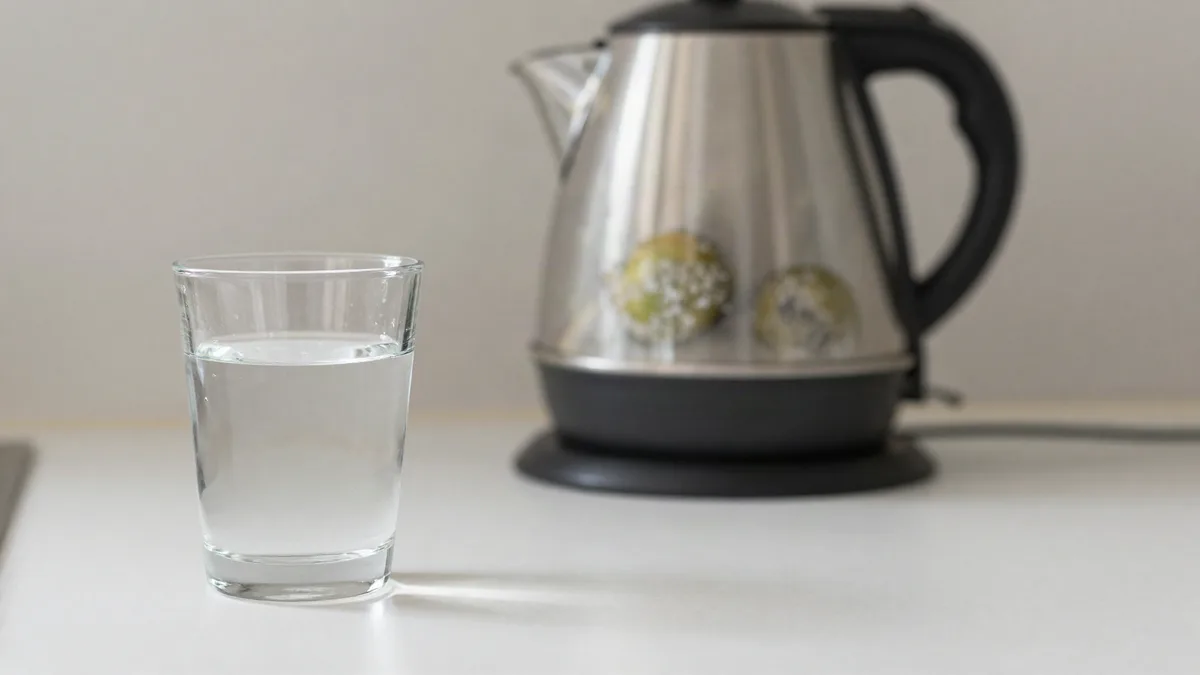
Short answer: No. Drinking hard water is not harmful — the World Health Organization sets no health-based guideline value for hardness, and the calcium and magnesium it carries may even be protective. Limescale's real damage is elsewhere: appliances, energy bills, skin comfort, and bacteria sheltering inside scaled water heaters.
Below is the evidence behind each half of that — including the parts that cut against what most water-treatment companies (us included) like to claim.
What limescale actually is
Limescale is calcium carbonate (CaCO₃) that precipitates when water is heated, evaporates or sits still. It is not a contaminant added to your supply — it is dissolved rock, mostly limestone and chalk, picked up underground.
The classification in the WHO's Hardness in Drinking-water background document (WHO/HSE/WSH/10.01/10/Rev/1, 2011):
| Hardness (mg/L CaCO₃) | Class |
|---|
| Below 60 | Soft |
| 60–120 | Moderately hard |
| 120–180 | Hard |
| Above 180 | Very hard |
You can check where your own address falls using our water hardness map.
Is drinking hard water bad for you?
No — and this is not a matter of interpretation. The WHO's conclusion is explicit: "There are insufficient data to suggest either minimum or maximum concentrations of minerals at this time, and so no guideline values are proposed."
There is no health-based limit for hardness anywhere in the WHO Guidelines for Drinking-water Quality. Where hardness is regulated at all, it is an aesthetic and operational parameter — taste, scaling, soap consumption — not a toxicological one. The minerals are nutrients: WHO estimates drinking water typically supplies 5–20% of daily calcium and magnesium intake, which matters most for people whose diets are already marginal in either.
The cardiovascular question, honestly. Catling et al. (2008) in the Journal of Water and Health pooled nine case-control and five cohort studies and found a statistically significant inverse association between drinking-water magnesium and cardiovascular mortality (OR 0.75, 95% CI 0.68–0.82).
We won't oversell that. WHO reviewed the same literature and concluded that "although there is some evidence from epidemiological studies for a protective effect of magnesium or hardness on cardiovascular mortality, the evidence is being debated and does not prove causality." A 120,852-person Dutch cohort (Leurs et al., 2010, Environmental Health Perspectives) found no relationship between hardness and heart disease mortality at all.
The defensible statement: there is no credible evidence that hard water harms your heart, and some evidence that the magnesium in it helps. That is the opposite of "limescale is dangerous."
It is also the strongest argument against stripping minerals out of drinking water. Ion-exchange softeners replace every calcium and magnesium ion with two sodium ions — WHO notes users "should be made aware of the changes in mineral composition that arise and the possible consequences for total nutrient intake." We cover the trade-offs in the hidden downsides of salt-based softeners.
Hard water, skin and hair
This is where the evidence gets genuinely interesting — and where the honest answer is "associated, but not fixable the way you'd assume."
The association is real. Perkin et al. (2016), in the Journal of Allergy and Clinical Immunology, studied 1,303 three-month-old infants in the UK and found high domestic CaCO₃ levels associated with substantially higher odds of atopic dermatitis (adjusted OR 1.87, 95% CI 1.25–2.80 in the high-hardness/low-chlorine group). Effect estimates were larger in infants carrying filaggrin (FLG) skin-barrier mutations, though that interaction was not statistically significant.
The 2021 meta-analysis by Jabbar-Lopez et al. in Clinical & Experimental Allergy pooled the observational data and confirmed increased odds of eczema in children exposed to harder water (OR 1.28, 95% CI 1.09–1.50). Mechanistic studies in the same review found higher deposition of the detergent sodium lauryl sulphate on skin washed in hard water — so the plausible mechanism is surfactant residue left behind, not calcium attacking skin.
Here is the part the industry skips. That same review examined two randomised controlled trials of ion-exchange softeners and found no significant improvement in objective eczema severity. The SWET trial (Thomas et al., PLoS Medicine, 2011) randomised 336 children with moderate-to-severe eczema: no difference in severity, night-time scratching, or topical treatment use.
So hard water is associated with a higher risk of developing eczema, but softening water is not a validated treatment for eczema you already have. Anyone selling a device on that promise is ahead of the evidence. What most people actually report is milder — tight skin after showering, dull hair, more product needed to lather. More in hard water, skin and hair.
Bacteria in scale: the one hygiene risk worth knowing
Scale is not inert. It is porous, it accumulates in the coolest zones of a hot-water system, and it shelters biofilm from disinfectant.
The US CDC's Legionella control toolkit names four key factors driving Legionella growth in potable water systems: sediment and biofilm, temperature, water age, and disinfectant residual. It recommends storing hot water above 140°F (60°C) and cleaning and maintaining water system components — water heaters explicitly included.
OSHA is blunter: "Water heaters maintained below 60°C (140°F) and that contain scale and sediment may foster Legionella growth," because "scale and sediment accumulate in these cool zones where the temperature can provide ideal conditions."
The honest framing: this is a system-hygiene issue, not a drinking-water issue. Legionella infects through inhaled aerosols, not through drinking, and outbreaks overwhelmingly involve large buildings and people who are older, immunocompromised or smokers. A scaled heater run below 60°C is a worse environment than a clean one — a defensible reason to control scale, not a reason to fear your tap.
Appliances and energy: where limescale actually costs you
Scale's thermal conductivity is roughly an order of magnitude lower than steel. It insulates the heating surface from the water it is meant to heat.
The clearest primary numbers come from the US Department of Energy's Steam Tip Sheet #7 (DOE/GO-102012-3597, 2012): "normal" scale 1/32 inch thick (about 0.8 mm) causes a 2.0% fuel loss; at 1/16 inch (1.6 mm), 3.9%; overall, "fuel consumption may increase by up to 5% in firetube boilers because of scale."
A caveat we owe you: those figures come from industrial firetube boilers, not domestic water heaters. The physics transfers; the exact percentage does not. You will also see "1 mm of scale = 7% more energy" repeated everywhere, including on some of our own older pages. We cannot trace it to a primary measurement, so we have stopped quoting it. The most-cited domestic figures come from a 2009 Battelle Memorial Institute study funded by the Water Quality Research Foundation, an industry body — credible engineering, but treat the headline percentages as directional.
WHO makes the appliance case in one sentence: hard water causes "scale deposition… in heated water applications where insoluble metal carbonates are formed, coating surfaces and reducing the efficiency of heat exchangers," while softened waters "allow more efficient heat transfer in exchangers and probably longer life of hot water heaters."
Our own position, stated the same way: an electronic descaler like LIMPEO changes how calcium carbonate crystallises so it adheres far less to pipes and heating elements, and it leaves calcium and magnesium in your water — unlike ion exchange. It does not remove hardness and it does not eliminate scale. The measured effect and the physics are in the science section.
When to worry — and when not to
Not worth worrying about:
- Drinking hard water. No health-based guideline exists because none is warranted.
- White deposits in your kettle — calcium carbonate, the same compound in a calcium supplement.
- Cloudy ice or a chalky film on glassware. Cosmetic.
Worth acting on:
- An older water heater on very hard water, especially if set below 60°C — scale plus lukewarm storage is exactly the combination CDC and OSHA flag.
- Rising energy use on an electric heater with a scaled element.
- Infants with eczema in a very hard water area — worth raising with a clinician, while knowing softeners are not an evidence-backed treatment.
- Kidney-stone formers: evidence is genuinely mixed. Hard water raises urinary calcium but also citrate and magnesium, both stone inhibitors; a 2020 systematic review in Current Urology Reports concluded the impact of hardness on stone formation remains unclear. Ask your urologist, not a salesperson.
FAQ
Is limescale bad for you? No. Limescale is calcium carbonate, and the WHO has never set a health-based guideline value for hardness because the data do not support one. Its harms are to appliances, energy efficiency and skin comfort — not to your body from drinking it.
Is limescale dangerous? Not in the water you drink. The one documented risk is indirect: scale and sediment in hot-water systems shelter biofilm and Legionella from disinfectant, which is why CDC and OSHA advise storing hot water above 60°C and cleaning water heaters. That is maintenance, not poisoning.
Is limescale harmful to your health? No credible evidence says so. The calcium and magnesium forming limescale are nutrients supplying 5–20% of daily intake, and pooled data suggest drinking-water magnesium is associated with lower cardiovascular mortality — though WHO stresses causality is unproven.
Can you drink water with limescale in it? Yes. Scale flakes from a kettle are unappealing but harmless. There is no maximum hardness limit in the WHO Guidelines for Drinking-water Quality, and hard water is drunk safely by hundreds of millions of people daily.
Does hard water cause eczema? It is associated with higher risk: a 2021 meta-analysis found OR 1.28 (95% CI 1.09–1.50) in children, and Perkin et al. (2016) found adjusted odds up to 1.87 in infants. But two randomised softener trials showed no improvement in existing eczema — a risk factor, not a treatable cause.
Sources
- World Health Organization, Hardness in Drinking-water: Background document for development of WHO Guidelines for Drinking-water Quality, WHO/HSE/WSH/10.01/10/Rev/1, 2011.
- World Health Organization, Calcium and Magnesium in Drinking-water: Public Health Significance, 2009.
- Catling LA, Abubakar I, Lake IR, Swift L, Hunter PR. "A systematic review of analytical observational studies investigating the association between cardiovascular disease and drinking water hardness." Journal of Water and Health, 2008;6(4):433–442.
- Perkin MR, Craven J, Logan K, et al. "Association between domestic water hardness, chlorine, and atopic dermatitis risk in early life." Journal of Allergy and Clinical Immunology, 2016;138(2):509–516.
- Jabbar-Lopez ZK, Craven J, Logan K, et al. "The effect of water hardness on atopic eczema and skin barrier function: a systematic review and meta-analysis." Clinical & Experimental Allergy, 2021;51(3):430–451.
- Thomas KS, Koller K, Dean T, et al. "A randomised controlled trial of ion-exchange water softeners for the treatment of eczema in children (SWET)." PLoS Medicine, 2011;8(2):e1000395.
- US Centers for Disease Control and Prevention, Controlling Legionella in Potable Water Systems, reviewed January 2025.
- US Occupational Safety and Health Administration, Legionellosis: Control and Prevention.
- US Department of Energy, Clean Firetube Boiler Waterside Heat Transfer Surfaces, Steam Tip Sheet #7, DOE/GO-102012-3597, 2012.
- Battelle Memorial Institute for the Water Quality Research Foundation, Softened Water Benefits Study: Energy Savings Detailed Report, 2009. (Industry-funded.)