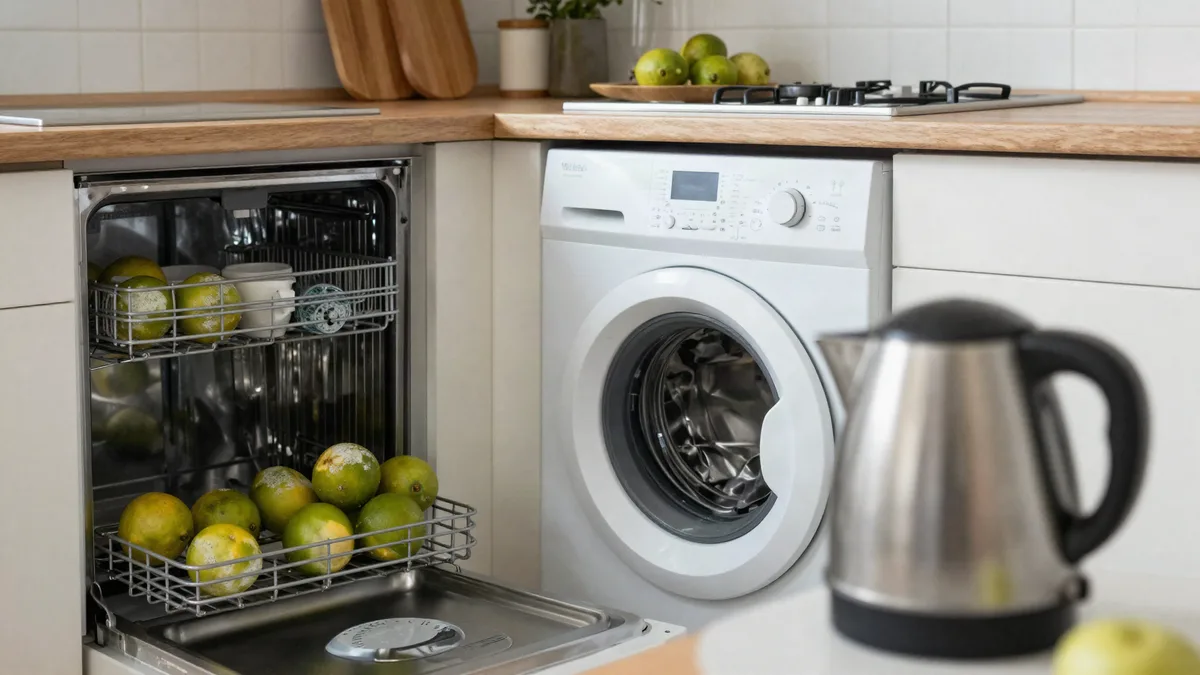
Hard water and appliances: the link is measured, and it is expensive. Above roughly 25 °f (250 ppm CaCO₃), limescale settles on everything that heats water — washing-machine element, water-heater tank, espresso thermoblock — and you pay for it three times over: in energy, in repairs, in early replacements. The documented orders of magnitude: up to 25.5% efficiency lost on a gas water heater in very hard water, and 528 to 907 g of scale deposited per year depending on the appliance (Battelle/WQRF study), i.e. a realistic €150 to €400 per household per year. Below, appliance by appliance — washing machine, dishwasher, water heater, kettle, coffee machine, iron, taps — with 2026 figures and sources in plain sight.
The hidden cost of hard water on your appliances
Hard water doesn't just leave white marks on your faucets. It silently attacks every appliance in your home that uses water, reducing their efficiency, increasing your energy bills, and considerably shortening their lifespan.
Cumulated over ten years, the premature replacement of appliances plus the energy overconsumption caused by scaled-up heating elements typically lands in the €1,500 to €4,000 range per household in a hard-water area. It never appears as a "limescale" line on a bank statement, which is precisely why it goes untreated.
The washing machine: the primary victim
Your washing machine is the appliance most exposed to limescale because it heats water with every cycle. Limescale precipitates more when water is heated, which accelerates scaling.
The heating element
This is the most vulnerable part. Limescale deposits layer after layer on the element, forming an insulating crust that:
- Prevents heat transfer to the water
- Forces the element to work harder to reach the programmed temperature
- Increases electricity consumption by 15 to 25%
- Causes overheating that eventually burns out the element
Replacing a heating element costs between 80 and 200 euros (parts + labor). In very hard water areas, it needs replacing every 3 to 5 years instead of the normal 10 to 15 years.
The drum and seals
Limescale also deposits in the drum, on perforations and paddles. The rubber door seals become clogged and stiff, losing their watertight seal. Residual moisture combined with limescale promotes mold growth and bad odors.
Internal plumbing
Inlet and outlet pipes gradually narrow from limescale buildup. Flow decreases, wash cycles lengthen, and leak risk increases.
The dishwasher: visible and invisible damage
Spray arms
The small holes in spray arms gradually clog with limescale. Water no longer sprays properly, pressure drops, and cleaning performance suffers. Your glasses come out with white marks and dishes aren't perfectly clean.
Heating element and filter
Like the washing machine, the dishwasher's heating element scales up and consumes more energy. The main filter clogs more quickly with limescale residue, requiring more frequent cleaning.
Glassware: irreversible clouding
The most frustrating phenomenon: your glasses become progressively cloudy. This whitish haze isn't just a surface deposit — it's chemical etching of the glass caused by the interaction between limescale, detergents, and heat. Once established, this cloudiness is irreversible. Only prevention works.
The kettle: the visible warning sign
The kettle is often the first appliance where limescale is noticed, as the buildup is directly visible.
In hard water areas, it takes just 2 to 4 weeks for a significant layer of scale to appear at the bottom. This deposit:
- Increases heating time (water takes longer to boil)
- Releases particles into your drink (white flakes floating in your tea)
- Reduces the lifespan of the heating element (2-3 years instead of 5-7)
- Alters the taste of water and hot beverages
Coffee machines and espresso makers: compromised precision
Coffee machines are particularly sensitive to limescale because they operate with narrow water circuits and high temperatures — two conditions that accelerate scaling.
Limescale blocks internal circuits, reduces extraction pressure (for espresso machines), alters optimal brewing temperature, and changes the taste of coffee. A scaled espresso machine produces under-extracted, acidic coffee with no crema.
Manufacturers recommend descaling every 1 to 3 months in hard water areas. The cost of descaling products adds up, and each incomplete descaling leaves residue that accumulates.
Steam irons and steam generators
Limescale blocks steam vents, reduces steam output, and causes dirty water spluttering that stains clothes. High-end steam generators are particularly vulnerable: untreated scaling can require complete boiler replacement, often as expensive as a new unit.
Summary table: cost of limescale per appliance
| Appliance | Normal lifespan | Hard water lifespan | Replacement cost |
|---|
| Washing machine | 10-15 years | 6-8 years | 400-800 euros |
| Dishwasher | 10-12 years | 6-8 years | 350-700 euros |
| Water heater | 15-20 years | 8-12 years | 800-1,500 euros |
| Kettle | 5-7 years | 2-3 years | 30-80 euros |
| Coffee machine | 5-10 years | 3-5 years | 100-500 euros |
| Iron/Steam generator | 5-8 years | 3-5 years | 50-300 euros |
Hard water and appliances: what it costs per year
The table above gives lifespans. Here is the same reality as an annual budget, for a four-person household on 30 °f (300 ppm) water — the common case across the Paris Basin, the north and the east of France. Conservative orders of magnitude, based on observed repair prices and real service lives.
| Appliance | What limescale shortens | Estimated annualised cost |
|---|
| Water heater (electric or gas) | Efficiency, element, descaling call-outs | €60-150 |
| Washing machine | Element, seals, extra detergent | €25-50 |
| Dishwasher | Little, if the salt reservoir is kept filled | €10-20 (regenerating salt) |
| Kettle | Serial replacements | €10-25 |
| Coffee / espresso machine | Narrow circuits, warranty conditions | €20-60 (descaler + repairs) |
| Iron / steam generator | Boiler, steam channels | €10-30 |
| Taps and shower | Aerators, thermostatic cartridges | €15-40 |
| Household total | — | €150-400/year |
Over ten years that is €1,500 to €4,000 — several new appliances' worth, spent without ever showing up as a "limescale" line anywhere.
How to protect all your appliances with one solution
Traditional solutions — anti-limescale tablets, white vinegar, chemical descalers — are temporary band-aids. They treat symptoms after the fact without preventing scale formation.
LIMPEO acts at the source: installed on the main water inlet, it treats 100% of the water entering your home. It does not remove calcium — your hardness reading does not change. It alters the way calcium carbonate crystallises, favouring aragonite, a less encrusting form; this effect has been observed in published laboratory work (Coey & Cass, 2000, Journal of Magnetism and Magnetic Materials; Kobe et al., 2001). These are laboratory findings on crystallisation, not a guaranteed percentage of scale removed in a given home — anyone quoting you a precise figure is overselling.
Benefits for your appliances:
- Protected heating elements: no insulating limescale crust, optimal energy consumption
- Clear pipes: water flow maintained, no risk of blockage
- Whole-home coverage: one device on the main inlet, every appliance downstream
- Zero maintenance: no tablets, no descaling, no chemicals
- No consumables: no salt to buy, no cartridge to replace, a few watts of power
FAQ: Hard water and appliances
Can limescale really break my washing machine?
Yes. A scaled element overheats and eventually burns out — one of the most common washing-machine failures in hard-water areas. In the Battelle/WQRF study, machines fed 26 gpg water showed generalised internal scaling after 240 accelerated cycles, while the softened-water machines came out essentially clean. Replacing an element costs €130 to €250 plus a call-out fee, which is often enough to push a household into buying a new machine instead.
Are anti-limescale tablets for washing machines enough?
Anti-limescale tablets (like Calgon) slow down scaling but don't prevent it completely. They add a monthly cost of 5-10 euros and only protect one appliance. They also contain phosphonates whose environmental impact is questioned.
Why do my glasses come out cloudy from the dishwasher?
Two possible causes: a surface limescale deposit (reversible by rubbing with vinegar) or glass etching (irreversible). In hard water areas, even with regenerating salt and rinse aid, the problem eventually appears. Only preventive water treatment at the source can stop it.
Does LIMPEO also protect the water heater?
Yes — it sits on the main inlet, so the water heater is downstream of it like everything else, and it is the appliance with the most to gain since it heats the largest volumes continuously. Be clear on what to expect, though: the treatment targets the formation of new scale, it is not a descaler. A heater that is already heavily furred up should be descaled first.
Does hard water really damage appliances?
Yes, and it has been measured. In the Battelle/WQRF study, gas water heaters on very hard water lost up to 25.5% efficiency over their service life, electric heaters accumulated 907 g of scale a year, and low-flow taps clogged after the equivalent of 19 days of use — none of which happened on softened water.
Which appliance suffers most from hard water?
The water heater, by a distance: it heats the largest volume of water, and domestic hot water accounts for roughly 11% of a home's energy use. Then the washing machine, then the espresso machine with its one-to-two-millimetre circuits. The dishwasher is the one appliance that protects itself — provided you keep the salt reservoir filled and set the hardness correctly.
At what hardness should I protect my appliances?
Below 15 °f (150 ppm), treatment is rarely worth it. Between 15 and 25 °f, routine maintenance usually does the job. Above 25 °f (250 ppm) prevention starts paying for itself; above 35 °f it is hard to argue against. Check your own figure first — see our hard water map of France.
Is limescale damage covered by my appliance warranty?
Usually not. Most manufacturers class scaling as a lack of maintenance rather than a manufacturing defect, and coffee-machine and steam-generator manuals explicitly require periodic descaling. In practice, a burnt-out scaled element is at your expense.
Discover how LIMPEO works and calculate your potential savings on our products page.
Further reading
To protect all your appliances with a single installation, check our appliance anti-scale solution. Our hard water guide explains how to measure and treat your water hardness.