What is the normal lifespan of a water heater?
An electric water heater (storage tank) has a theoretical lifespan of 10 to 15 years. A heat pump or solar water heater can last 15 to 20 years. But in hard water areas, this lifespan is often cut in half.
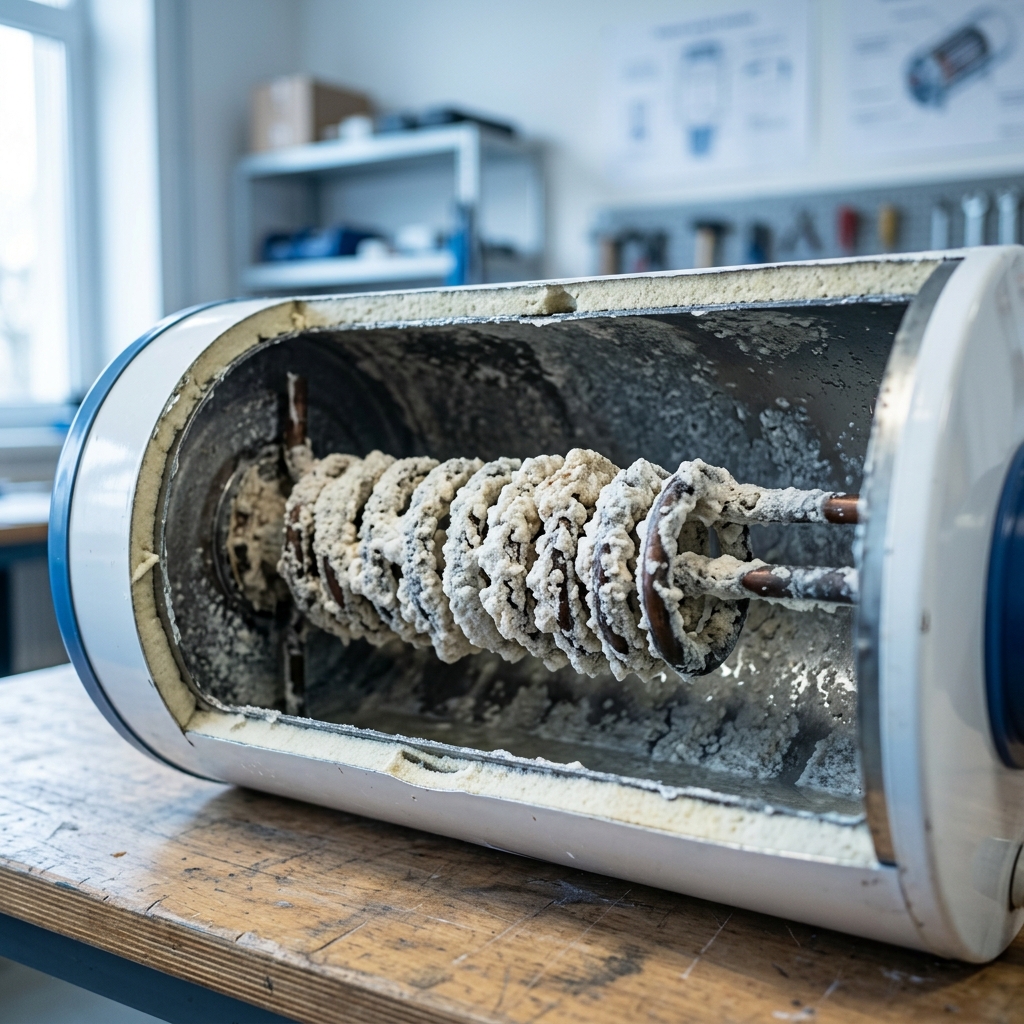
The main culprit? Limescale — calcium carbonate (CaCO₃) that deposits on the heating element, the tank walls and the magnesium anode.
How limescale destroys your water heater
1. Heating element scaling
The heating element is the core component of the tank. Limescale forms an insulating layer that:
- Increases energy consumption: +7% per millimetre of limescale (source: ADEME)
- Causes the element to overheat (risk of burnout)
- At 3 mm of limescale: +21% on the energy bill
Read also: Limescale costs you 25% on your energy bill.
2. Premature anode consumption
The magnesium anode (or sacrificial anode) protects the tank against corrosion. In hard water, it wears 2 to 3 times faster because limescale creates zones of differential corrosion. Once the anode is exhausted, the tank starts to rust from the inside — the beginning of the end.
3. Reduction in usable volume
Limescale accumulates at the bottom of the tank and progressively reduces the available hot water volume. A 200-litre tank can lose 20 to 50 litres of capacity within a few years in 30°f water.
4. Warning signs
- Popping noises during heating — limescale expands under the heating element
- Less hot water than before — the element is losing efficiency
- Rising bills — overconsumption due to limescale insulation
- Rust-coloured water — the anode is exhausted, the tank is corroding
Impact by water hardness
| Water hardness | Estimated lifespan | Heating element scaling |
|---|---|---|
| < 15°f (soft) | 12 – 15 years | Negligible |
| 15 – 25°f (moderately hard) | 8 – 12 years | Moderate (descaling every 3-5 years) |
| 25 – 35°f (hard) | 6 – 8 years | Significant (descaling every 1-2 years) |
| > 35°f (very hard) | 4 – 6 years | Critical (frequent element replacement) |
Consult the hard water map of France to find out your situation.
How to protect your water heater
LIMPEO electromagnetic treatment
LIMPEO, designed by MAGIIC SAS, uses electromagnetic waves to transform calcite into aragonite. Aragonite micro-crystals do not deposit on the element — they remain suspended and are flushed away with the water. The result:
- reduction in limescale on the heating element — scientifically validated
- Protected element → optimal energy consumption
- Preserved anode → extended tank lifespan
- Maintained usable volume → no accumulation at the bottom
- 10-minute installation, zero maintenance for 10 years minimum
Discover our technology, review the scientific studies and explore our product range. Calculate your savings with our online tools.
FAQ — Water heater and limescale
How do I know if my water heater is scaled?
Signs include: popping noises during heating, less hot water than usual, rising energy bills, rust-coloured water. A professional descaling allows you to assess the thickness of the deposit.
Should I descale my water heater?
In hard water areas (>25°f), descaling every 1 to 2 years is recommended. In very hard water (>35°f), annually. LIMPEO drastically reduces the need for descaling by preventing limescale from forming.
Does LIMPEO really protect the water heater?
Yes. By transforming calcite into aragonite, LIMPEO prevents limescale from depositing on the heating element and tank walls. The effectiveness is validated by scientific studies. The element stays clean, the anode is preserved, and the tank lifespan is extended.
Steatite or standard water heater: which resists limescale better?
The steatite water heater (element protected in a sleeve) resists better because the element is not in direct contact with water. However, limescale still accumulates on the sleeve and in the tank. LIMPEO protects both types.
At what temperature should I set my water heater?
French regulations require a temperature between 55°C and 60°C to prevent Legionella proliferation. This temperature accelerates limescale precipitation, making LIMPEO treatment even more relevant.